Youth involvement in the energy sector was discussed at the All-Russian Personnel Forum
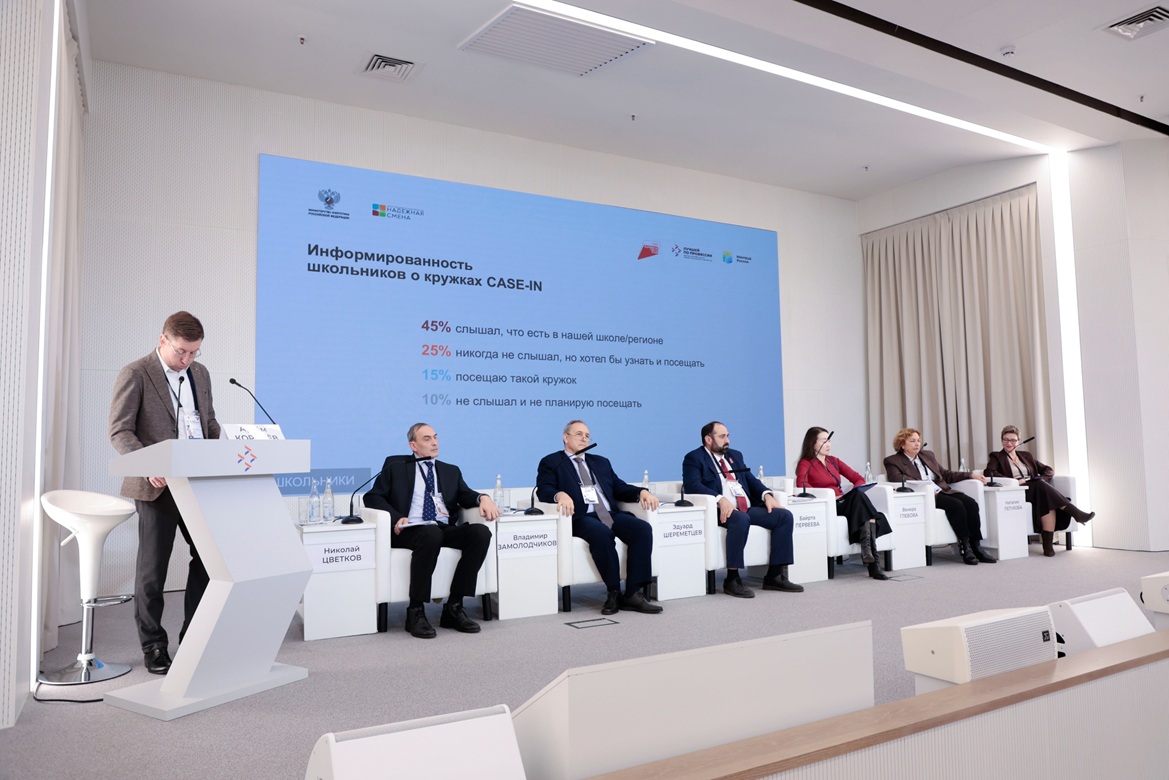
A panel discussion "Russian Engineering Schools: the Personnel Aspect of Energy Strategy" was held at VDNH in Moscow as part of the All-Russian Personnel Forum. Representatives of government authorities, energy companies, universities and schools discussed the future of engineering education and measures to train a new generation of personnel for the Russian fuel and energy complex.
Eduard Sheremettsev, Deputy Minister of Energy of the Russian Federation, was the first to address the participants of the discussion, presenting the Ministry of Energy's Energy Classes project aimed at attracting 300,000 young specialists to the industry by 2030.
"Currently, about 2.8 million people are employed in the energy sector, and according to the most conservative estimates, by 2030 we need to attract about 300 thousand more people., – he noted. – We see a trend that the professions of the energy complex are becoming more and more popular among young people, but at the same time we note that only about 30% of graduates go to work in their engineering specialty. Therefore, it is necessary to create an ecosystem where every student or student should dream of becoming an engineer of the future. And one of the effective tools is early career guidance. Together with interested employers, we have already started to create a system of engineering classes in schools. There are already about 500 of them in operation, and by 2030 their number will exceed 600."
The key challenge of the industry was formulated by the moderator of the discussion, Artem Korolev, director of the Reliable Change Foundation, founder of the International Engineering Championship CASE—IN: "We need not just qualified specialists, but strong, creative, proactive professionals capable of technological breakthroughs, responsible management decisions and strengthening the technological sovereignty of the country. Russian engineering schools play a special role in this process, which can and should become the foundation for the training of such personnel."
The participants were presented with research data from the Reliable Shift Foundation. Schoolchildren, students, young professionals, university professors and school teachers appreciated the attractiveness of engineering professions and the existing education and training system.
A study among students showed that more than 80% consider a career in energy attractive. The majority positively assess training and participation in practice-oriented projects, but 12.5% noted the lack of practical teachers, which became one of the key topics of discussion.
Member of the Management Board, HR Director of JSC "System Operator of the Unified Energy System" Bayrta Perveeva told how the company works with future specialists.: "Students can get the necessary practical skills and knowledge of regulatory documentation only directly from their employer. In the System Operator, this is realized through integration with universities. Today, we have 27 partner universities across the country, with which cooperation agreements have been concluded and joint action plans are implemented annually. Students complete production and pre-graduate internships at the company: Appointed supervisors work with them, they get acquainted with the specifics of the company's activities and prepare final qualification papers based on the actual tasks of the System Operator. In addition, we have three flagship universities where undergraduates study in specialized programs developed according to the company's requests. Their peculiarity is that classes are taught not only by teachers, but also by employees of the System Operator. During their studies, we accept students as interns: they work in the services of the technology and information technology units, combine theory with practice, and study business processes and industry specifics from the inside. As a result, graduates of these programs come to us as already qualified specialists, deeply immersed in the profession and the company's activities."
According to Natalia Petukhova, ALROSA not only regularly participates in the International Engineering CASE-IN Championship and other major federal projects, where it is looking for talented young specialists, but also develops its own personnel training system.: "The company has a comprehensive career guidance system that includes many projects, for example, Olympiads, specialized days at summer children's camps, ALROSA Technomodule, Profi Club, and ALROSA classes. 90% of graduates of corporate classes enroll in specialized partner universities, complete internships at ALROSA, and then come to work with us. At the start of their career, young professionals are involved in project activities and, with the support of mentors from among top managers, implement their own initiatives. The achievements of young professionals are collected on the ALROSA digital platform.Force, an individual development plan is being implemented for the ranking leaders."
The young professionals who participated in the study reported that they lacked mentors, practical equipment skills, digital competencies, and soft skills. They identified five key problems: a shortage of practicing teachers, short internships, a lack of real-world cases, and poor development of soft skills and digital training.
Nikolay Tsvetkov, Head of the Personnel Development Department at Gazprom Energoholding LLC, emphasized the need to strengthen applied training: "There are few and only a few practical teachers with teaching experience and working in companies today. But they are especially in demand in production today. I believe that it is necessary to increase the share of internships and internships for university teachers. For example, our company has an annual internship program for teachers: now Gazprom's flagship universities are joining it, but we will be glad to see representatives of all energy universities. In addition, it is important to increase R&D in universities and involve young teachers in their implementation. In my opinion, one of the most effective approaches is to create competence centers for industrial partners at universities. Such centers allow companies to formulate and solve specific industry tasks, and students and teachers to jointly search for solutions, while developing the necessary practical skills."
63% of university teachers pointed to the lack of fundamental training of applicants, 37% — to the poor development of partnerships with industry.
Vladimir Zamolodchikov, Acting Rector, First Vice-rector of the National Research University "MEI", emphasized the high potential of the industry: "Energy as a profession is beyond competition and is always in demand, and this attracts young people for whom professional self—realization is important. It is very important for us, starting from the first year, to keep students interested in their future profession, and this is achieved through cooperation with companies in the energy industry and their projects aimed at deeper professionalization of our students. In addition, the industry needs leaders, and we at MEI need a role model. Therefore, we have formed a line of educational programs "Etalon", within which we train leaders: we give them advanced fundamental training and so-called soft-skills. The percentage of graduates enrolled in graduate school in this line is 5 times higher than in the university as a whole."
Interest in energy is also high among schoolchildren, the youngest participants in the study: 44% consider the profession attractive, 70% — prestigious and modern. 45% are familiar with CASE-IN engineering circles, 25% would like to participate in them.
Venera Glebova, director of Moscow School No. 1317, noted the importance of popularizing specialized mathematics: "The rejection of engineering professions is largely due to the fact that high school students are afraid to take specialized mathematics, this is the most difficult exam for our graduates Venera Glebova explained. - In general, the study of exact sciences is a big problem, for which several programs have been developed. So, this year in the capital's education system, the project "Entertaining Mathematics for young Muscovites" was launched in elementary schools, classes of Mathematical vertical are already operating, Pre-professional classes, including Engineering classes and IT classes in Moscow schools, in secondary schools for grades 10-11, and CASE-IN educational circles in the system of additional education.. These initiatives introduce students to engineering professions and help them develop mathematical and analytical thinking."
Based on the results of the panel discussion, proposals were formed to strengthen Russian engineering schools and improve the quality of training specialists for the fuel and energy sector.
Artyom Korolev summarized the results of the meeting: "The discussion allowed us to combine the expertise and practical experience of the participants and became a step towards creating conditions for the formation of a truly strong generation of engineers who will ensure technological sovereignty and sustainable development of the Russian fuel and energy complex.".
More news
-
The winner of the CASE-IN championship became the "Student of the Year 2025" in St. Petersburg
08 Dec 2025 -
Artem Korolev summed up the results of November in his Telegram channel
07 Dec 2025 -
The MGSU National Research University team will present a project for the development of the Krasnoyarsk Territory in the final of the CASE-IN champio
05 Dec 2025 -
Young specialists from 12 companies are preparing for the final of the Autumn CASE-IN Cup
05 Dec 2025
Чтобы оставаться в курсе последних новостей, подписывайтесь на нас: