A new look at the bowels of Yakutia: innovative solutions for the development of the Oleneksky district
The participants of the Exploration direction of the XIV season of the International Engineering CASE-IN Championship proposed solutions that make it possible to search for minerals in the Arctic more accurate, economical and technologically advanced. The championship is held with the support of the Presidential Platform "Russia – the land of opportunities".
In the main season, students had to identify the most promising sites for development in the Oleneksky district of the Republic of Sakha (Yakutia). The teams analyzed the geological structure of the territory, assessed the prospects for finding scarce minerals, developed logistics for field work in the Far North, and calculated the economic efficiency of projects.
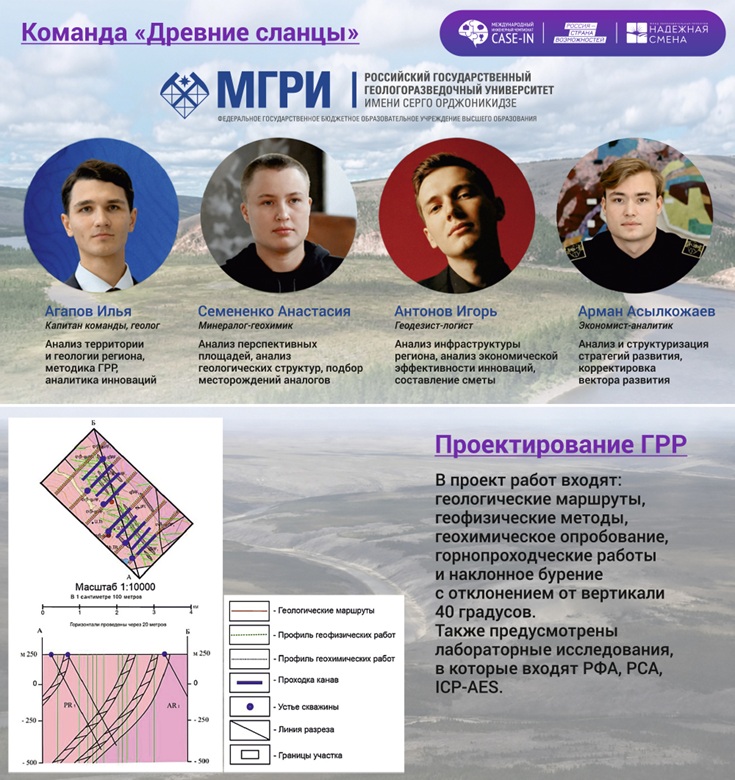
The winner of the competition was the Ancient Shales team of the Moscow State Geological Exploration University (MGRI), which proposed using artificial intelligence as a digital assistant to a geologist. The system developed by the students allows you to automatically plan expedition routes based on weather conditions and winter conditions, reducing transportation costs and reducing time loss during the field season. This approach can significantly improve the efficiency of geological exploration in hard-to-reach areas, including Yakutia.
The team "Chthonologists" of St. Petersburg Mining University became the silver medalist. The team's project focuses on the search for niobium and other industry—critical rare metals. To improve the accuracy of the research, the students proposed using unmanned aerial vehicles that perform aerial and geophysical surveys at ultra-low altitudes, which allows for much more detailed information about the structure of the subsurface and reduces the amount of time-consuming ground research.
The bronze medal was won by the Bedrock Bums MGRI team. The authors focused on reducing the time of geological exploration by creating a closed digital data cycle. The project provides for the use of mobile laboratories for operational analysis of samples directly in the field and modern communication systems that ensure data transmission even in areas with a lack of stable infrastructure. This makes it possible to make decisions on further exploration faster and reduce the cost of exploration.
Experts note that most of the teams used similar technological approaches. Among them are the use of artificial intelligence for processing geological data and planning work, the introduction of unmanned technologies in conducting aerogeophysical research, the use of mobile analytical complexes for rapid assessment of samples directly in the field, as well as the search for critically important types of mineral raw materials necessary to ensure the technological sovereignty of the country.
The finalists' work shows that modern geological exploration is becoming a high-tech industry in which digital tools, automation and economic modeling are becoming as important as knowledge of geology. The students' solutions demonstrate how the development of the Arctic territories can be in the coming years: more accurate, safer and cost-effective.
More news
-
Students of the DPR were invited to a CASE-IN to compete for career prospects
06 Oct 2026 -
Artem Korolev on social media – about team values, the risks of AI, and the power of the CASE-IN community
04 Oct 2026 -
От практического кейса к карьере: студентов колледжей и техникумов девяти регионов России приглашают на CASE-IN
02 Oct 2026 -
Молодежный день откроет Российскую энергетическую неделю
02 Oct 2026
Чтобы оставаться в курсе последних новостей, подписывайтесь на нас: