From unmanned dump trucks to "green" aluminum: St. Petersburg students have developed breakthrough solutions at the CASE-IN Championship
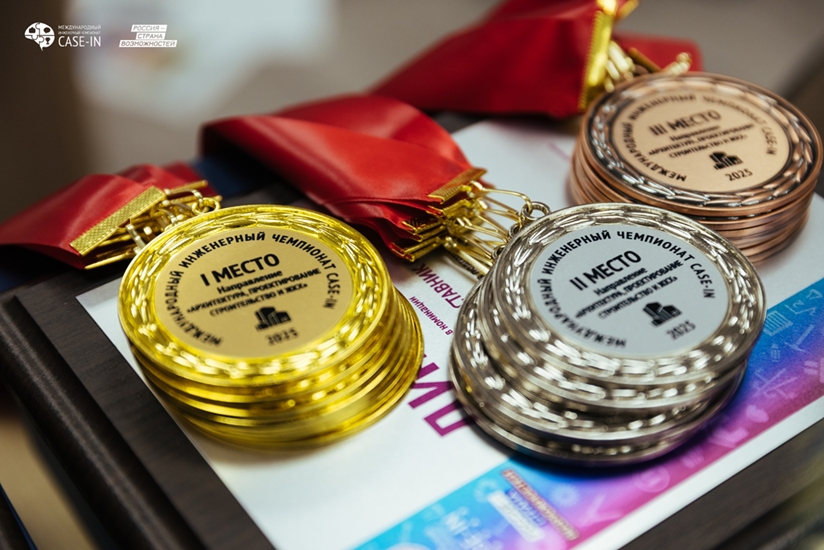
Seven teams from St. Petersburg have become winners and prize-winners of the XIV season of the International Engineering CASE-IN Championship, which is supported by the Presidential Platform. "Russia is a land of opportunity." Students from four specialized universities have developed solutions for the domestic industry, impressing the expert community with their extraordinary thinking.
Students of the Northern Capital entered the top three in key industry areas: Architecture, Design, Construction and Housing and Communal Services, Geological Exploration, Metallurgy and Digital Automation. The students developed projects for a multifunctional Comfort class residential complex and unmanned dump trucks, solutions to improve the efficiency of aluminum mining, as well as to search for mining sites in the northern regions.
Students from St. Petersburg took all the prizes in the field of Architecture, Design, Construction and Housing and Communal Services. They have managed to develop promising projects for a modern seven-storey building with underground parking and commercial premises in Yaroslavl.
The polyForma team from Peter the Great St. Petersburg Polytechnic University (Alexander Kolosov, Polina Shirokova, Anton Smotrin, Nikita Anisimov, Ilya Kazinsky, Elizaveta Kotarskaya and Vera Zorina) became the winner of the competition. The project they were working on was based on the "cultural code" of Yaroslavl as the birthplace of the Russian theater. They suggested using the rhythmic step of the arches and traditional Yaroslavl tiles, reinterpreted in a modern style. The bright colors of the facades, in their opinion, serve as a backdrop for bright accent entrances, and the hinged ventilated facade ensures the durability and energy efficiency of the building. The project involves the distribution of buildings with the creation of an enclosed courtyard. According to experts, the project stood out from the competition due to its in-depth study of the historical context.
"This competition has become not only a serious challenge for our team, but also a valuable experience. We were glad to have the opportunity to put our theoretical knowledge into practice and see how it works in real conditions. We were helped to win the first place by the perseverance of the entire team and the support of numerous teachers who accompanied us throughout our participation. We are sincerely grateful to everyone who believed in us and helped us achieve this result.",– said the team member Vera Zorina.
Silver medals were won by another St. Petersburg Polytechnic University team, MonArchi, which included Karina Kambulatova, Olga Zamaraeva, Alexey Muromsky, Valeria Cherentaeva, Svetlana Trubitsyna, Nikita Lapshin and Georgy Litvin..
The experts highly appreciated the technical detail of the winners' solutions, which designed a complex of six buildings with variable storeys (from 6 to 9 floors). Special attention was paid to engineering systems: detailed axonometric schemes of heating, ventilation and water supply were developed with the placement of equipment in basements and technical rooms. The design block included detailed diagrams of load-bearing structures and plans for the excavation enclosure.
"Participation in the competition was an impetus for us to develop and overcome ourselves. Both before the qualifying stage and before the final, we consulted a lot with the teachers of the SPbPU Institute of Civil Engineering, who are real professionals. Thank them for their help. We tried to take every little detail into account, to make a project that we could really be proud of. Sometimes it was hard, but thanks to clear planning, initiative, and a desire to reach a new level, we were able to climb the podium.",– noted by a team member George Litvin.
The third place was taken by the team of the St. Petersburg State University of Architecture and Civil Engineering Six Seven: Kirill Besedin, Polina Orlova, Olga Gavrichenkova, Daniel Oksana, Lyubov Belogrivova, Kirill Ivanov, Anna Yarullina.The students' project has become a benchmark in terms of the formation of a residential environment and landscaping. With a total area of more than 44,500 m2 and 247 apartments, the architects were able to create a cozy ecosystem. The concept includes not only standard playgrounds, but also artificial ponds, pedestrian alleys and specialized dog walking areas. The complex-shaped main building is integrated into a system of "quiet recreation areas", which provides a high level of privacy for residents.
"Our students are particularly proud: the Six Seven team won a bronze medal in a competition with the strongest rivals. I sincerely congratulate the guys and wish them new bright victories and creative success!"– noted by the Head of the Department of Construction Organization of St. Petersburg State University, Candidate of Technical Sciences Roman Motylev.
The student teams of the region also successfully performed in the direction of "Digital Automation", offering solutions for the introduction of unmanned dump trucks at the mining and processing plant.
The UNEC team became the vice-champion in this field.tech from St. Petersburg State University of Economics. Dmitry Yanshin, Mikhail Berezhnykh, Yaroslava Menshchikova, Valery Cherevko we focused on mathematical optimization of transport cycles. They were able to prove that the AI core allows them to cope with peak loads with a fleet of only five cars, whereas the traditional approach would require ten units of equipment. The project includes a system of "virtual fences" and a multi-layered logic for collision avoidance in mixed traffic conditions. The financial model has shown exceptional stability with an internal rate of return of 70%.
The Nomine Bigas team representing Peter the Great St. Petersburg Polytechnic University (Sofya Paritskaya, Irina Dryganova, Vladislav Kondratov and Nikita Ryabkov) won bronze medals in the Digital Automation field.The project architecture is based on multi-agent training for dynamic dispatching. A unique feature of the project is a robotic battery quick-change cell that minimizes downtime. There is also a special "security layer" that hardware blocks any commands that could lead to an accident. According to experts, the team has proposed the most futuristic and technologically sophisticated AI solution stack.
"When we saw a post in the institute's group about holding the open qualifying stage of the XIV International Engineering CASE-IN Championship in the field of Digital Automation, after consulting with the team, we decided to participate and test our knowledge. The championship provides a good opportunity to try yourself in solving real production tasks. It so happened that as a result of the selection, we became one of the two teams that reached the finals. We decided that we shouldn't stop there, so we went to the finals in a fighting mood and won the bronze medal.",– shared the captain of the team Sofia Paritskaya.
Students of the St. Petersburg Mining University of Empress Catherine II, united in the team "Chthonologists", won the silver awards of the championship in the field of "Geological Exploration". Dmitry Khamkhoev, Kira Dubinova, Leonid Klochkov and Vadim Savchenko We were able to figure out how to efficiently and safely deliver people and equipment to the remote northern region.The winners relied on a scientific approach and the search for scarce raw materials – niobium and rare metals, which are critically important for modern industry. To find hidden deposits deep underground, they suggested using drones flying at ultra-low altitudes (only 15-20 meters above the ground). This technology allows you to "see" through the soil 4-6 times more clearly than conventional methods, and saves geologists from having to manually bypass vast expanses of tundra.
The team "Metal 4.0" (St. Petersburg Mining University of Empress Catherine II) won in the field of Metallurgy. Ignaty Zaitsev, Gleb Yevgrafov, Mikhail Kustov and Kirill Grishanov We have proposed an efficient and environmentally friendly way to launch new aluminum production facilities.The students conducted an in-depth scientific study comparing 11 different technologies according to a variety of criteria. Their solution reduces the time required to prepare the equipment for operation to 44 hours. The long-term economic impact of the project is estimated at hundreds of billions of rubles. The development ensures high-quality coking of interblock joints and increases the service life of the well.
"We have developed a combined method for safely starting the equipment. First, the structure is gradually heated with special diesel burners, and then liquid aluminum is poured inside and current is applied. At the same time, a protective salt solution created by the team is added to the hearth – a heavy electrolyte with the addition of barium and lithium fluorides. Due to the difference in weight, this compound forms a barrier between the hot metal and the carbon graphite base, seals microcracks and prevents aggressive sodium from destroying the elements. Calculations have shown that the technology reduces the preparation time of the equipment to two days, increases its service life by a third and saves 370 thousand rubles at each launch.",– shared the captain of the team Kirill Grishanov.
According to experts, the decisions of St. Petersburg students can be applied in practice after detailed refinement. The main advantages of the development are the improvement of modern urban infrastructure, the transition to unmanned resource extraction, new ways to exploit the riches of Yakutia, and the production of "green" aluminum with a low carbon footprint.
"Students from St. Petersburg traditionally set the bar high at the CASE-IN championship. They regularly win medals and are rightfully considered one of the most decorated participants in our competition. This season, the guys have once again confirmed their high class, taking awards in four key areas at once. But the main thing is the quality of their engineering solutions, which have great practical potential and can become drivers of development for entire sectors of the domestic industry." ,– noted the founder of CASE-IN Artem Korolev.
The organizers of the CASE-IN championship are the Reliable Change Foundation, the Presidential Platform Russia – the Land of Opportunities, the Non-profit Partnership Youth Forum of Mining Leaders and AstraLogica LLC. The CASE-IN International Engineering Championship is included in the "Science to Win" initiative and the plan for the Decade of Science and Technology, which takes place in Russia in 2022-2031.
More news
-
Tyumen students have developed solutions for economic development
18 Jul 2026 -
How to use Yakutia's gas without main pipelines: decisions of the winners of the CASE-IN championship
17 Jul 2026 -
From School physics to big engineering challenges: the Story of CASE-IN Ambassador Anastasia Ustyuzhanina
14 Jul 2026 -
Artem Korolev told how to become the head of the company and choose the "right door"
11 Jul 2026
Чтобы оставаться в курсе последних новостей, подписывайтесь на нас: