From idea to patent: how school projects become industrial developments thanks to CASE-IN
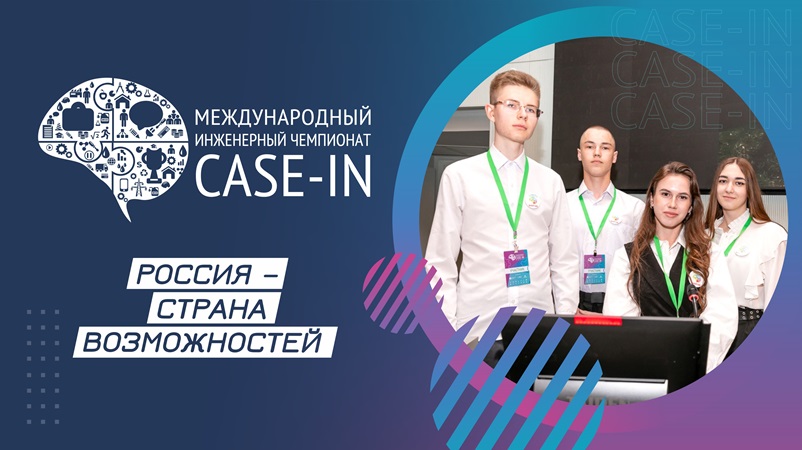
Schoolchildren at the International Engineering CASE-IN Championship, which is held with the support of the Presidential Platform "Russia – the land of opportunities", create technological projects for the development of leading areas of the Russian Federation. The guys go from a child's idea to registration with Rospatent, and also receive attention from the real sector of the economy.
Sergey Kovtun, a high school student from the city of Raduzhny, who studies at the children's technopark "Kvantorium", thought about how to minimize the human factor and prevent emergencies at gas stations. The problem was well-known: according to statistics, a significant part of incidents at gas stations are caused by drivers who forget to turn off the engine or leave with a fuel pistol left in the tank. Together with his mentor Vladimir Panchenko, the student began work on a device that could automatically block dangerous actions.
At the first stage, Sergey developed a sketch and a schematic diagram of the system, combining a microcontroller, light, distance and sound sensors, a relay and a boom servo. This is how the current prototype was born — a hardware and software complex based on the Arduino Uno platform, capable of recognizing a running car engine by sound and vibration, as well as monitoring whether the gun is returned to the pump. In 2024, the young inventor submitted the project to the Big Challenges competition, where he took first place at the regional stage, as well as to the CASE-IN championship, where he won second place in the school league.
The feedback and recognition received allowed the Yugorchanin and his teacher to reach the final stage — filing an application with the Federal Service for Intellectual Property (Rospatent). In September 2025, the patent for the utility model "Gas Station Security System" was successfully registered, and the Sibirius Talent Workshop became the copyright holder of the development. The cost of the serial sample, according to the author's calculations, is about 5,9 thousand rubles, which makes the device affordable for gas station owners. Vladimir Panchenko, the inventor's mentor, emphasizes that this system has no analogues on the Russian market today, and its implementation at real facilities of the fuel and energy complex is only a matter of time.
Egor Palkin, a tenth-grader from Khakassia, has designed an ambient air analysis device for enterprises of the fuel and energy complex. Unlike expensive single-parameter industrial analogues, its microcontroller-based system monitors four critical indicators at once: temperature, the presence of flammable and non-flammable gases, dustiness and the presence of flames. In 2024, Egor presented the project at the school league of the International Engineering CASE-IN Championship, where he became the winner among 340 participants from 40 regions in the individual competition in the field of "Engineering and technical creativity".
Although at the moment there is no open information about the patent registration, the victory in the championship gave the young inventor the right to additional points for the Unified State Exam, an invitation to educational forums at the All-Russian Children's Centers "Eaglet" and "Smena", as well as direct access to potential industrial partners from among the fuel and energy complex companies.
Teachers and managers of children's technology parks note that the path from idea to implementation requires a built ecosystem. Successful examples usually include three components: access to modern hardware and software, work in a competitive environment with feedback from experts, and competent patenting of developments with the involvement of professionals. In Ugra, Quantorium projects receive legal support and assistance in commercialization, and winning the CASE-IN championship automatically opens the doors of partner universities and industry forums for students, where they can present their inventions directly to representatives of large businesses.
It is this combination of children's initiative, professional mentoring and working with real market demands that turns teenagers' curiosity into real technological solutions that are in demand by the industry.
More news
-
A graduate student at UL University helped South Africa win a historic CASE-IN Championship
19 Jun 2026 -
Future architects and builders from Khakassia shared their experience of participating in the final CASE-IN
18 Jun 2026 -
The expert of RTSoft – Smart Grid is a member of the winning team of the CASE-IN championship
16 Jun 2026 -
From idea to implementation: Engineering Thought Factory projects are becoming a driver for the development of energy and human resources in the Krasn
15 Jun 2026
Чтобы оставаться в курсе последних новостей, подписывайтесь на нас: