Schoolchildren from 10 regions became finalists of the "CASE-IN" with lean technologies
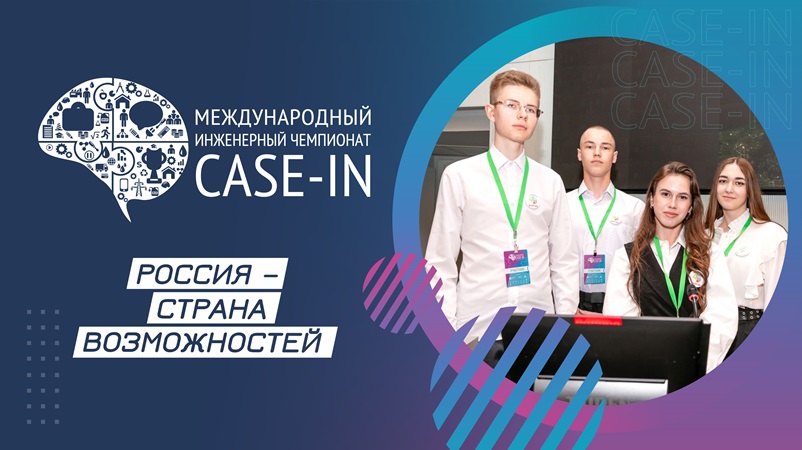
13 teams of high school students from 12 schools in 10 Russian regions reached the final of the School League International Engineering Championship "CASE-IN» with the support of the presidential platform "Russia – the land of opportunities". The authors of the strongest decisions are waiting for a trip to Moscow, additional USE points and opportunities for further development.
The project is included in the "Science to Win" initiative and the plan for the Decade of Science and Technology, which takes place in Russia in 2022-2031. It is being implemented within the framework of the federal project "Social Elevators for Everyone" of the national project "Education". The project is being implemented using a grant from the President of the Russian Federation for the development of civil society.
"During the School League competitions, participants from 40 regions we performed tasks on the topic of "Lean manufacturing", – said the founder and co-chairman of the organizing committee of the International Engineering Championship "CASE-IN" Artem Korolev. – Teams of high school students were assigned by SIBUR's strategic partner to solve the case "Lean Technologies for Sustainable Development", and students in grades 3-11 were engaged in engineering and technical creativity with the support of Evraz LLC and the Alabuga SEZ. In total, the contestants presented 150 projects and solutions."
In the qualifying stage directions of "Case solving" More than 350 high school students of grades 9-11 participated.
On the instructions of SIBUR, the teams of schoolchildren selected one of the priority industries in Russia and analyzed its condition. Then the contestants developed solutions based on lean manufacturing tools that will allow this industry to develop more efficiently. The participants presented their projects to experts from companies and specialized organizations.
13 of the 94 competing teams will travel to Moscow for the final of the CASE-IN championship.
Among the finalists, 5 teams represent Moscow and the Moscow region.
"Gentlemen" from Moscow school No. 334 We analyzed the activities of the Tver Carriage Building Plant, the main supplier of Russian Railways wagons. To solve the problems facing the plant and the railway industry, the team members proposed using a droid, an artificial intelligence and analytical support system that would manage the company's energy sector with minimal staff intervention. The second idea was the MES - Manufacturing Execution System, a system for monitoring all processes in production. The students drew up a roadmap for the implementation of their solution, calculated the risks and financial costs.
Another one reached the final team schools No. 334 – "Zolotnik". The team members developed a solution for the Bobrovsky oil field in the Orenburg region: they proposed using alternative energy sources by installing solar panels in combination with a diesel generator. According to the students, the implementation of their idea will create new qualified jobs and help to quickly adapt employees. In addition, the company will be economically profitable and will reduce carbon dioxide emissions into the atmosphere by 60%.
Contestants from The Uncertainty Principle commands, representing Moscow school No. 117, We have developed a project to save electricity and reduce consumers' energy costs.
"If we establish a connection between electrical appliances in private apartments and dispatchers who, with the consent of individuals, will turn off operated devices that are not essential for the consumer at the moment, then this can reduce the cost of electricity during peak hours.", - participants note in their work. The students calculated the energy consumption of the most popular appliances and devices – lamps, boilers, air conditioners, underfloor heating, heated towel rails - and calculated the savings from the application of their project.
"Big bosses" from school No. 1317 (Moscow) We investigated the challenges facing the oil and gas industry.
"To increase the competitiveness of the industry, it is necessary to actively introduce innovations and modernize production, which requires significant investments., - high school students argue, - In general, the petrochemical industry in Russia is facing challenges, but with the right development strategy, investments in innovation and modernization, as well as market diversification, it can maintain its position and even strengthen in the future."
As a solution, the contestants proposed using horizontal wells in oil and gas fields, which would increase rock permeability and increase oil production efficiency. Horizontal drilling will reduce overall production costs and environmental impact, according to the finalists.
The "Hype" team of Domodedovo Lyceum No. 3 She focused on ways to process red sludge, a highly toxic waste generated during aluminum production.
"We need to develop a scheme that allows us to extract the maximum amount of valuable components from red sludge and is safe for the environment", - the students consider. They have developed a project that allows processing red sludge to produce rough alumina, iron, titanium and scandium concentrates, as well as white soot. The project can be implemented within a year and will generate 1.3 million rubles of revenue for processing 100 tons of red sludge.
For the second year in a row, they reach the finals The "smart girls" from Lyceum No. 86 in Yaroslavl. The team members focused on the timber industry and proposed integrating 3D scanning technology of timber into the production process with mathematical calculation of optimal cutting locations. For drying timber, a system should be used that reduces defects in the wood structure, and product quality should be monitored using non-destructive mechanical and ultrasonic flaw detection methods. The implementation of the Yaroslavl team's solution will lead to the "zero waste" principle, the renewal of production logistics, the retraining of personnel and the reduction of CO2 emissions.
"The developed solutions not only contribute to productivity improvement, but also comply with the principles of sustainable development and rational use of resources", - the finalists comment.
The Landau team represents the design school of Magnitogorsk State Technical University named after G. I. Nosov in Magnitogorsk, Chelyabinsk region and it was logical to focus on the study of metallurgy.
"Our team visited Magnitogorsk Iron and Steel Works as part of an excursion and personally got acquainted with the organization of production. Having examined the production chain from coking coal to the production of hardware, we identified the "bottlenecks" in the production process and compiled a flow map", - the finalists from the Southern Urals tell in the annotation.
The high school students' solution is based on the introduction of lean manufacturing tools with an emphasis on the organizational, technological and digital potential of the enterprise.
"Our team estimated the cost of developing and implementing the proposed solutions at 195.1 million rubles, - the authors of the development explain, - Thus, PJSC MMK, with its production potential and the availability of labor resources, is able to increase its own efficiency by further improving the production process and increase profits by 54,506.046 million rubles."
The finalists also explored the problems of metallurgy development SLD teams from school No. 4 in the village of Golyshmanovo, Tyumen region. Using the example of the Elektrostal Tyumen metallurgical plant, which processes scrap metal collected in the region, the contestants developed recommendations: "smoothing" the production plan, using visualization tools, quick changeover, protection from unintended errors and streamlining the workplace and continuous training of employees.
"Capybaras" from Granovskaya secondary school in Irkutsk region We researched the aircraft industry and proposed solutions for implementation at the Irkutsk Aviation Plant. The idea of high school students includes the robotization of the production process, the introduction of artificial intelligence and continuous staff training.
"We propose the creation of specialized classes in schools where students will be able to study engineering subjects, specialized disciplines in depth and become interested in aircraft construction., - students comment, - We also consider it advisable to introduce the study of the basics of lean manufacturing in universities, where students will be able to get acquainted with the basics and by the time they start working in production they will be able to apply them in practice, which will help reduce the time spent on training new employees and increase their work efficiency."
Members of the Integration team they are engaged in The Center for Children's Scientific and Engineering Creativity "UnikUm" at Kuzbass State Technical University. The finalists from Kuzbass have developed recommendations for the United Aircraft Corporation.
"Our solution is called the Innovative Machine-building Complex, and it includes measures to introduce lean manufacturing into machine-building complexes and measures to create qualified personnel."- the high school students explain .
The finalists focused on the training of qualified employees and the involvement of students who will have to implement smart equipment and organize autonomous production: create a digital warehouse twin, collect data, implement artificial intelligence, Wi-Fi, devices for monitoring defects and capacity. All these measures should lead to an increase in production efficiency by an average of 40-50%.
Decision 5 DIM teams from the Vysotka High School in Gubkinsky in the Yamalo-Nenets Autonomous District It is dedicated to the development of the oil and gas industry.
The participants focused on a solution to prevent corrosion on pipelines: "In our work, we consider the section of the gas pipeline loop (a type of field gas pipelines) - the most emergency section in the entire production."
The students conducted several experiments to choose the best way to prevent metal corrosion.
"The introduction of pipes made of materials that are not susceptible to corrosion will completely eliminate losses due to the corrosion factor (90% of accidents), and the costs of combating the corrosion factor, which resources are spent on, will also disappear", - schoolchildren from Yamal conclude.
Finalists from Ignite teams, high school students of school No. 10 in the city of Guy, Orenburg region We analyzed the development of the mining industry in Russia and justified the introduction of lean production mechanisms using the example of the Gaisky Mining and Processing Plant.
The high school students have developed solutions that will allow them to maintain the rhythm of ore delivery between processing sites without increasing the fleet of dump trucks, reduce the risks of occupational diseases and improve the working conditions of employees.
"According to preliminary calculations, the introduction of these technologies may bring additional profits of about 122 billion rubles to PJSC GGOK over 10 years, and additional contributions to the state budget will amount to about 230 million rubles.", - the contestants are counting.
Kremlin Analysts are finalists from the village of Aginskoye in the Trans-Baikal Territory, students of the Aginsky District Boarding School We studied the development of the petrochemical industry and proposed the introduction of liquefied natural gas technologies and natural gas processing into the activities of SIBUR.
According to the authors, their solution will improve energy efficiency, reduce the environmental burden and increase the competitiveness of the enterprise.
"LNG expands SIBUR's raw material base and reduces the risks associated with fluctuations in fossil fuel prices., - students comment, - LNG can be a more economical source of energy than other fuels, especially in remote areas or with limited infrastructure. The use of LNG contributes to the achievement of the company's sustainable development goals and creates a positive image."
In the final of the School League, which will be held on May 29 in Moscow, the teams will have to prove to the expert community the effectiveness of their decisions. In addition, they will receive valuable advice from specialists from industrial companies and will be able to master important professional skills.
The champions and prize–winners of the School League will receive diplomas, valuable gifts and a certificate for additional USE points upon admission to bachelor's degree programs at one of the partner universities of the championship. In addition, they will receive invitations to industry youth educational forums at the VDC "Eaglet" or VDC "Smena".
The organizers of the CASE-IN championship are the Reliable Change Foundation, the Non-profit Partnership Youth Forum of Mining Leaders and AstraLogica LLC.
More news
-
A tenth grader from the Republic of Khakassia is among the winners of the CASE–IN championship
21 May 2024 -
Young specialists of Vitsebskenergo became the third at the national qualifying stage
21 May 2024 -
A schoolgirl from Voronezh became the silver medalist of the CASE-IN championship
20 May 2024 -
Three teams are winners of the System Operator Case Solving Championship
18 May 2024
Чтобы оставаться в курсе последних новостей, подписывайтесь на нас: