CASE-IN Championship - to help teachers and schools
In some countries, the title of engineer is still added to the surname when representing a person. This highlights the importance of engineering for the economy of a particular country and for society as a whole. And we are obliged to pay the necessary attention to this, and we will certainly do so. I must say that the number of university applicants who apply for engineering specialties is growing quite rapidly. All this work should start from school.
Vladimir Putin, President of the Russian Federation
Relevance for the country, region, and school. The formation of Russia as an innovative state, stated in the Presidential Decree "On the national Development Goals of the Russian Federation for the period up to 2030," determines the need for the education system to focus on the formation of innovation competencies among the country's citizens, necessary for an innovative economy and technological sovereignty. At the same time, NBICS convergences (nanotechnology, biotechnology, information, cognitive and social technologies) form the basis of social progress in the modern global innovation space today. The interrelation of these development vectors determines the need to introduce interdisciplinarity into the process of general education, which will allow modern schoolchildren to develop the ability to integrate knowledge from different fields of culture in order to find the most optimal solution to the problem.,
A high level of interdisciplinary education is possible only with a qualitative change in the entire educational environment, including teaching technologies, the availability of equipment for collective and individual practical work, the organization of research activities for schoolchildren, and early professional testing in production and educational laboratories. The requirements of the Federal State Educational Standard for metasubject results contain references to interdisciplinary or suprasubject concepts, the meaning of which expands only when studying several sciences. Project and research activities are becoming an obligatory component of modern education. In this context, the problem of intensive search for optimal models of educational content and organizational forms, methods and tools that contribute to the effectiveness of the educational process, including in the context of integration of basic and additional education, networking, is noted.
Statistical data published The Higher School of Economics highlights the problem of the shortage of qualified scientific and engineering personnel for many regions of our country, including St. Petersburg. In this regard, one of the ways to achieve the strategic goals of the Russian National Project "Education" is to create new approaches to career guidance for schoolchildren. The priorities of St. Petersburg's socio-economic policy, defined in the Strategy for the Socio-Economic Development of the city until 2035, are the basis for innovative projects in the region's pre-professional education system.
In 2023, pre-professional classes were opened in 239 schools in St. Petersburg in nine areas, where students can develop their talents and abilities, choose the right path for their future career, undergo high-quality admission training, professional trials, and learn their first real profession at school. For training in such programs, which involve network partners (colleges, universities and enterprises), modern laboratories and workshops equipped with the latest equipment are being created. In St. Petersburg, the city Government allocated more than 2.5 billion rubles for the organization of such classes.,
A comprehensive solution aimed at developing new formats for organizing the educational process, developing innovative elements of the early career guidance system and the basics of pre-professional training for schoolchildren, was the project to create an Engineering Competence Development Center for Schoolchildren. As a result of the competitive selection in 2021, a grant from the Government of St. Petersburg was received for the project to equip specialized classrooms. As a result, 8 high-tech laboratories were equipped: "Engineering Graphics and modeling", "Smart Home", "Industrial and mobile robotics", "Creation of unmanned vehicles based on computer vision", "Laboratory of human-machine interaction", "Modern Programming", "Laboratory of Experimental Sciences", "Virtual Reality Technology and augmented reality." The Engineering Center has become a kind of intermediary between schools, colleges, universities and
enterprises.
Today, developing the ideas of engineering education and focusing on the logic of an interdisciplinary approach, the teaching staff of GBOU school No. 334 purposefully creates conditions for the formation of a practice-oriented educational environment of a new type, actively involving social partners in interaction. The educational institution has 1,980 students, and specialized classes have been opened in the main school: Kurchatov (11th grade), Engineering Metrological (10th grade), Engineering Energy Class (9th grade), Automobile and Transport Class, and Engineering Technical Class (8th grade). Upon graduation in the summer of 2024, students will receive certificates of their first profession.: "Electrician of distribution networks" (program partners are Malookhtinsky College of St. Petersburg Mining University, PAO Rosseti Lenenergo); "Quality Controller of purchased products" (program partners are Petrovsky College, BSTU VOENMEH, VNIIM named after D.I. Mendeleev, PJSC Zvezda).
One of the priority areas of the school's work is the early identification, support, education and development of children's individual inclinations and talents, and the creation of an environment conducive to the fullest realization of their abilities in various fields of science and technology. Students of the school successfully compete in the championships of early career guidance and professional skills "Professionals. Juniors", "Abilimpics", "Skills of the young", "Seekers of a profession", as well as at technical competitions and Olympiads. Since 2020, with the support of the administration of the Nevsky District of St. Petersburg, the Consortium for the Development of School Engineering and Technology Education, and the National Coordination Center for UNESCO Associated Schools in the Russian Federation, GBOU School No. 334 has been organizing The All-Russian children's foresight "New Dimension", which provides an opportunity for children aged 6-11 to demonstrate their pre-professional skills in various competencies.
In November 2023, with a grant from the Russian Movement of Children and Youth, the Movement of the First, with the participation of a wide range of partners, the All-Russian foresight "New Dimension: Real Professions" was conducted in 13 technical specialties for schoolchildren in grades 5-8.
Briefly about the championship movement "CASE-IN".
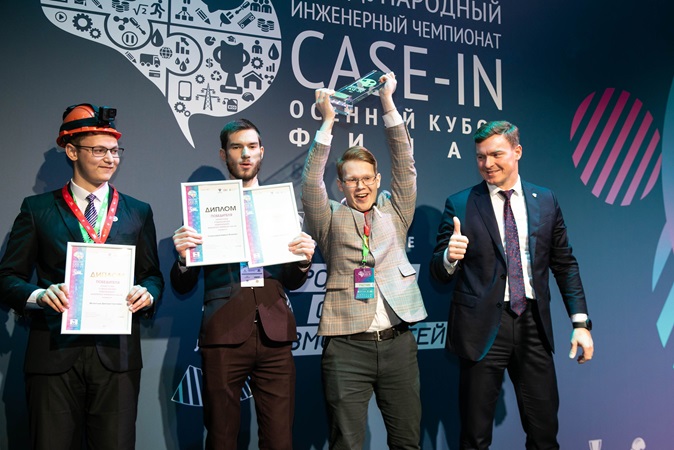
To show your talents, get an internship at a large company, enroll in one of the leading universities or make a fast-paced career - the projects of the presidential platform "Russia - the land of opportunities", created on the initiative of Vladimir Putin, help in all this. One of these projects in 2019 was the CASE-IN championship, aimed at supporting young engineers, schoolchildren, students and young professionals who want to develop professionally in the fuel and energy and mineral resource complexes.
The largest practice-oriented engineering championship in Russia and the CIS countries has been held since 2013. In 2023, it is included in the Action Plan (roadmap) of the Government of the Russian Federation to increase the prestige and demand for professions related to architecture and construction, as well as to introduce changes to educational programs in the areas of training specialists in the field of construction, ensuring accelerated involvement of students in production processes.
For all its participants and winners, this is a unique opportunity not only to declare themselves, but also in the near future to find a job in leading Russian companies in the field of fuel and energy (fuel and energy complex) and mineral resources complex (MSC).
There is competition in several leagues in the championship. The school league follows two directions - case solving and engineering and technical creativity. In the "case solving" direction, students in grades 9-11 develop an engineering case solution based on a real or near-real production situation or process related to the fuel and energy complex, MSC, nuclear industry or related industries. Students from elementary grades take part in the field of "Engineering and technical creativity" (a competition of projects in the format of essays, studies, presentations, layouts among students in grades 3-5, 6-8; a digital drawing competition among students in grades b-8; a competition of technical devices in the format of modeling, printing, IT projects and other formats among students in grades 9-11).
The League of Working Specialties is for students of secondary specialized educational institutions. Teams of up to 4 people from among students, undergraduates and postgraduates compete in the Student League in the following areas: geological exploration; mining; metallurgy; oil and gas; petrochemistry; project engineering; electric power industry, etc. The League of Young Professionals provides an opportunity for employees of companies and organizations in the fuel and energy and mineral resource complexes to compete in solving complex tasks.
A tool for success
According to A.V. Agafonov, First Deputy General Director of ANO Russia - the Land of Opportunities: "The platform provides a wide range of opportunities for self-realization, helps you decide on a profession, complete an internship or find your first job, get a mentor or new knowledge. The CASE-IN championship provides an opportunity for young people from different regions of Russia to develop by solving real production tasks, engaging in scientific and technical creativity and receiving an engineering education. The participation of several thousand participants in the project proves that the championship is a ticket to the future, allowing you to move up the career ladder, find your dream job and become a real professor."
Indeed, the winners and prize-winners of the School League are granted benefits upon admission to educational institutions of higher education that have included this project in the Admission Rules, as well as on the basis of the draft entry into the Order of the Ministry of Education of the Russian Federation dated August 31, 2023 N2 649 "06 approving the list of Olympiads and other intellectual and (or) creative competitions, events, aimed at the development of intellectual and creative abilities, physical education and sports, interest in scientific (research), engineering, inventive, creative, physical culture and sports activities, as well as the promotion of scientific knowledge, creative and athletic achievements, for the 2023/24 academic year."
The key to successful performance at the championship is the developed supra-professional skills that are necessary for a specialist in any professional field. The case study method and its adapted format for engineering specialties are becoming an active method of teaching such skills. Today, the engineering case is an integral tool for youth projects in the fuel and energy complex, MSC and industrial sectors, for career guidance for schoolchildren, student development and training, as well as the development and selection of young specialists.
An engineering case is a situational example containing a description of an engineering task that is "embedded" in a real industry situation, based on specific production and financial indicators, with several possible correct solutions and a specific set of data. Case information is presented in unstructured problems and often does not contain some of the data needed for analysis. Unlike tasks, cases do not have a clear solution algorithm and a single "correct" answer. Solving the case requires skills in analyzing, calculating, and searching for additional data.
Solving engineering cases involves teamwork in a limited period of time and defending it before an expert panel. Using the engineering case study method gives young people the opportunity to hone many useful skills: the ability to assign roles in a team, search, structure and analyze information, develop an agreed opinion, present and argue their ideas in communication with experts. Such an experience is necessary in the modern world. It is known that leading companies are fighting for engineering personnel, but do not forget that everyone needs the best.
In order to develop engineering thinking through students' familiarization with the case studies of the fuel and energy complex and MSK industries, the team of authors at school No. Z34 of the Nevsky District of St. Petersburg, with the support of the CASE-IN Championship Project Team, the Information and Methodological Center of the Nevsky District of St. Petersburg, developed an additional general development program "Preparation of solutions for engineering cases in as part of the International Engineering Championship "CASE-IN" for students aged 12-18. The program is aimed at studying real-world cases, as well as other types of engineering activities using case studies. In the classroom, students gain basic knowledge about the concepts of real production in important sectors of the Russian Federation (oil, gas, electric power); they get acquainted with the technique of creating the simplest solutions to engineering cases, technological techniques for performing case tasks of varying complexity, technology for preparing presentations, collecting information and speaking. An assessment toolkit has been developed to assess students' achievements.
The program corresponds to the social order of the society and the government of the Russian Federation for the training of future industry personnel and is implemented with the participation of mentors (partners of GBOU school No. Z34 of the Nevsky district of St. Petersburg) - students of the St. Petersburg Mining University of Empress Catherine II, employees of PJSC ROSSETI Lenenergo and experts of the Championship.
New features
The initiative of carrying out within the framework of the program The St. Petersburg International Educational Forum on the basis of GBOU school No. a 3Z4 of the Nevsky district of St. Petersburg of the regional stage of the International Engineering Championship "CASE-IN" for students of grades 8-11 received the support of the organizers of the forum.
As a result, a new career guidance platform is being created for the fuel and energy complex, the mineral resource complex, the nuclear industry and related industries for schoolchildren with the participation of teachers and students of specialized universities, representatives of enterprises, government authorities, scientific and educational centers of public and expert associations.
A source: electronic periodical "Pioneer"
More news
-
Young specialists of SUEK-Krasnoyarsk acquired practical knowledge at the "CASE-IN" championship
03 May 2024 -
Two school teams from Moscow became finalists of the CASE-IN championship
03 May 2024 -
Participation in the School's CASE-IN League will help you get into the Eaglet
02 May 2024 -
In the final, 10 student teams will present solutions for energy system management.
02 May 2024
Чтобы оставаться в курсе последних новостей, подписывайтесь на нас: