KuzSTU students effectively solve problems in the fields of energy and engineering
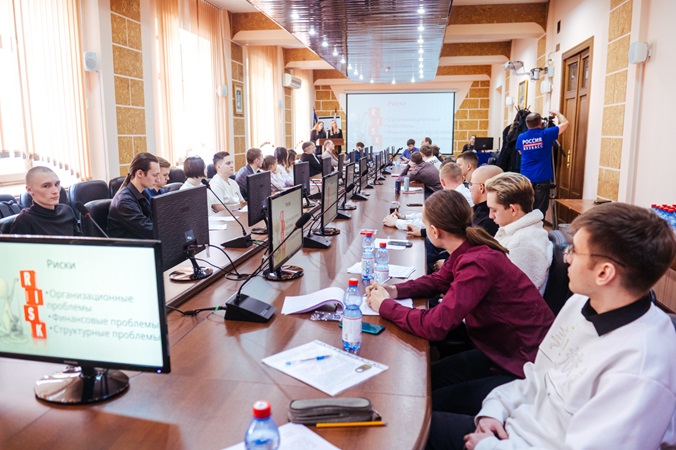
Design engineering, electric power and thermal power engineering – these areas are among the most in demand on the global market. It was in these areas that 34 teams presented their solutions during the qualifying stage. Student League of the XII International Engineering Championship "CASE-IN".
Electric power industry
The case study on the electric power industry was compiled by one of the world's largest electric grid holdings PJSC ROSSETI. The participants of the championship developed plans to reduce accidents and improve the reliability of electrical networks in Moscow and the region, using digital technologies, predictive analytics, innovative developments of the company and other lean manufacturing activities.
The EDS team won this challenge (Elizaveta Kartashova, Yaroslav Avdeev, Anastasia Ustyuzhanina, Konstantin Shulikov). To reduce the accident rate of electrical networks, the guys proposed three solutions: install a digital electrician, an energy storage system and an alpha platform.
"A digital electrician will simplify people's work, allow them to quickly determine the location of a breakdown and the degree of its impact on the power system. The principle of operation of the energy storage system is that it accumulates excess generated electricity at night, and returns it back to the grid in the morning in order to smooth the load schedule. Alfa Platform will integrate all solutions into a single dispatching system of the Russian energy system", – said the captain of the team Yaroslav Avdeev.
The silver medalists were the Golden Boar team (Danila Pyrsikov, Danil Doroshkevich, Mikhail Fatin, Gleb Sidoryuk). For time-consuming production stages, students have "introduced" universal solutions: automated systems for managing equipment maintenance and diagnostics of a power transformer; a software and hardware complex for recognizing and recording readings based on artificial intelligence; a staff retraining program for working with digital resources, and others.
The Vikings team (Roman Chernikov, Nikita Tishchenko, Vadim Ryzhkov, Roman Lukyanov) took 3rd place, noting the advantages of artificial intelligence for preventing meteorological emergencies, as well as a system for diagnosing power transmission lines using unmanned aircraft. In addition, the students proposed to introduce into production a selective system for detecting damaged connections and lightweight supports for restoration work.
Thermal power engineering
Gazprom Energoholding LLC, Russia's largest owner of electric power assets, compiled the assignments in this area. The teams should propose and justify ways to provide consumers with thermal energy by switching thermal loads from boiler houses to CHP plants. The initial data includes the parameters of the heat supply system, generating equipment, and aggregated unit costs.
The winner was the 4Energy team (Pavel Fadeev, Artyom Kuznetsov, Gordey Meshkov, Anna Tyra). The students simulated switching using the Zulu GIS software, and from lean manufacturing activities they proposed to retrain boiler rooms for storage and training laboratories, implement interactive whiteboards, digital assistants for thermal inspectors and drones to detect local accidents. The result of such solutions will be the creation of a centralized energy supply system, reduction of financial losses and development of innovations.
"Our plan to switch the load from local boilers to thermal power plants and hot water systems from an open to a closed circuit is designed for 72 million rubles with a payback period of about four years. It will not only increase the efficiency of generating types of energy, but also improve the environmental situation by reducing emissions.", – said Artem Kuznetsov, a sophomore at the Institute of Energy.
Thermoeds (Dmitry Slizhuk, Evgeny Kunov, Ivan Nefedov, Maxim Pazderin) took the 2nd place, while the It's a Business team (Vadim Abulkhanov, Eduard Demin, Matvey Zuev) rounded out the top three. In their work, the students compared the economic indicators of the stations before and after reconnection.
Project engineering
The participants of the direction developed the concept of the engineering center for JSC NIPIGAZ, including the structure, organizational form and risk calculation. The center should be based on the principles of lean manufacturing with the ultimate goal of creating a polyolefin production facility in Omsk.
The experts awarded 1st place to the NFFL team (Stepan Afonin, Ulyana Feoktistova, Nikita Rusakov, Mikhail Goncharov), whose engineering center consists of the departments of management, lean manufacturing, ecology and sustainable development, marketing and sales, staff training, design and technical support.
"The relevance of our solution lies in the application of the principles and tools of lean manufacturing. In our opinion, the feature of the engineering center we have developed is a wide range of services aimed not at one specific enterprise, but at a possible multitude of different companies and industries.", – the captain of the team Stepan Afonin shared.
The Oval Forest team (Evgeny Fischer, Maxim Lyubimov, Oleg Siebert, Igor Chuev), whose development took 2nd place, considered the economic advantages before and after the introduction of the lean manufacturing concept into existing centers. In turn, the bronze medalists of "Slim" (Alexandra Nesterova, Natalia Kalacheva, Olesya Domozhilkina) developed the concept of the center, which provides services for personnel selection, market research and project management.
The winners of each of the directions of the "CASE-IN" championship will have to defend their decisions in the next stage. The final of the Student League will be held in Moscow at the end of May.
More news
-
100 students of Samara Polytechnic University competed in the "CASE-IN" qualifying stage
29 Mar 2024 -
10 St. Petersburg school teams competed for tickets to the "CASE-IN" finals
28 Mar 2024 -
Youth agenda of the Fuel and Energy Complex - effective projects for youth development
28 Mar 2024 -
YATEK launched the qualifying stage in NEFU
28 Mar 2024
Чтобы оставаться в курсе последних новостей, подписывайтесь на нас: