The digital standard of the future. What awaits SMART standards in an era of change?
Industry 4.0 (i4.0) is a term that has been frequently used in professional media in recent years. Its main features are the digital transformation of all sectors of the economy and the further deepening of individual business processes into digitalization, the massive introduction of cyber-physical systems (CPS) into production, the widespread use of the industrial Internet of Things (IIoT) and artificial intelligence (AI).
Fig. 1. Fundamentals of Industry 4.0

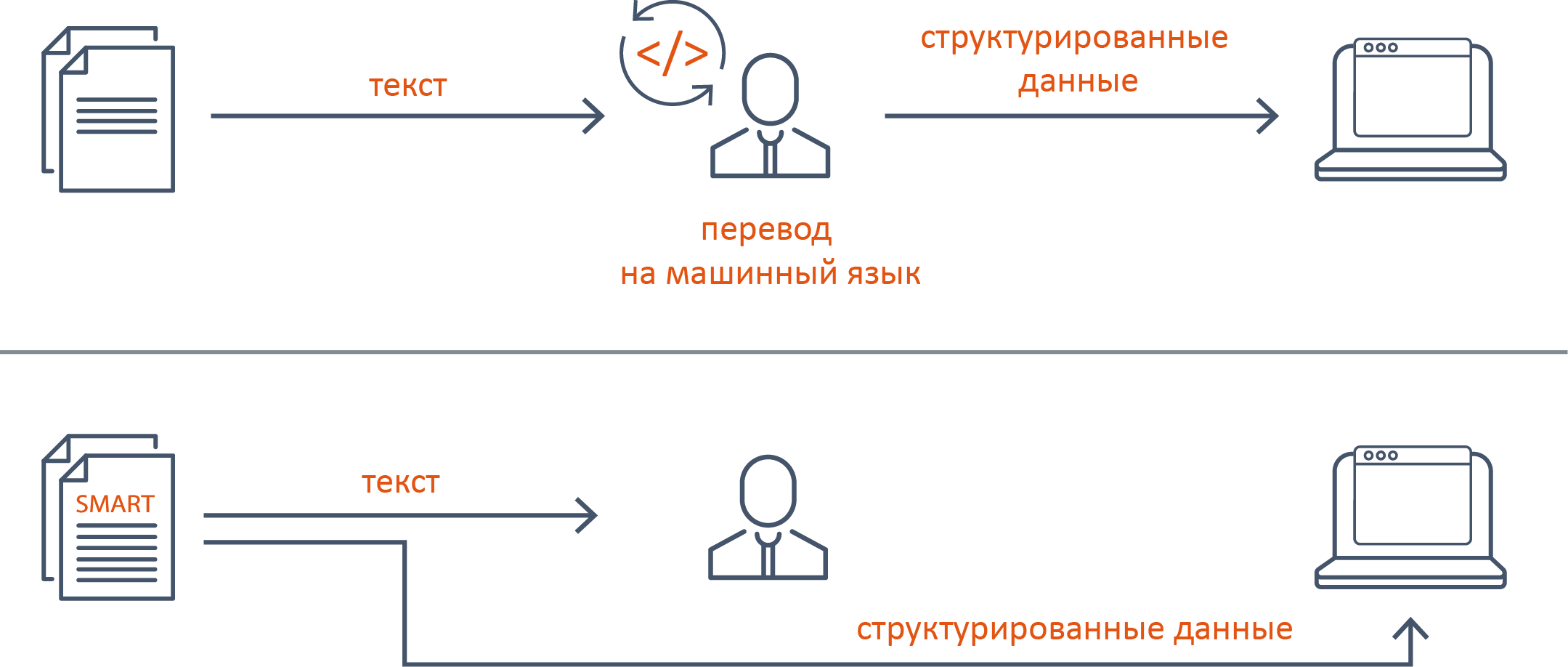
Without a transition to the values of i4.0, it is almost impossible to imagine building the future and ensuring its technical security. The SMART standard is also an integral part of Industry 4.0 - a new type of digital standards corresponding to the fourth level of digitalization development in the field of standardization according to the ISO/IEC classification. The main feature of this level is the achievement of such a quality of standards in electronic representation (presentation), which makes them machine—readable (machine-executable), that is, along with the ability to be read by humans, it makes it possible to process and use information and cyber-physical systems, bypassing humans.
Fig. 2. Regular document vs SMART standard
What stands in the way of further digital transformation, taking into account the latest economic changes? How will the concept of SMART standards develop in the era of change and in what areas will they be applicable? Let's look into this article, and at the same time find out what opportunities the domestic digital platform Techexpert provides to enterprises in the field of Industry 4.0.
What is SMART"the standard?"
The issue of defining and creating the first SMART standard in the history of Russia is being resolved at the highest level. For this purpose, a new Design Technical Committee "Smart Standards" (PTK 711) was established at Rosstandart in 2021. The Committee was headed by the governing organization of the Consortium of the same name, Codex JSC, and the Russian Institute of Standardization (FBGU PCT). By the end of 2021, PTK 711 included 30 industrial enterprises, industry associations, scientific institutions and IT companies. Thus, consumers of standards — entrepreneurs and industrialists, as well as the scientific community — are engaged in this task, trying to comprehensively understand what the regulatory document of the future should be.
In a broad sense, the abbreviation SMART stands for Standards Machine Applicable, Readable and Transferable — "standards applicable to machines, readable by machines and transmitted to machines." In other words, these are some kind of digital standards with a set of smart services that have a human-readable component, but can be transmitted and understood by machines without its participation. During the research work related to the activities of PTK 711, experts from the Codex Consortium, the ideological leader of this concept, searched for the most accurate definition of a SMART standard. The researchers settled on the following:
A SMART standard is an electronic standardization document containing regulatory requirements for standardization objects, which is an object of an information system of standardization documents and is presented as a container of unstructured and structured data. It allows software processing to reproduce the human-readable content of a document and services for working with the content, as well as a set of machine-readable and machine-readable data for transmission and processing in various information systems.
Fig. 3. Contents SMART standards
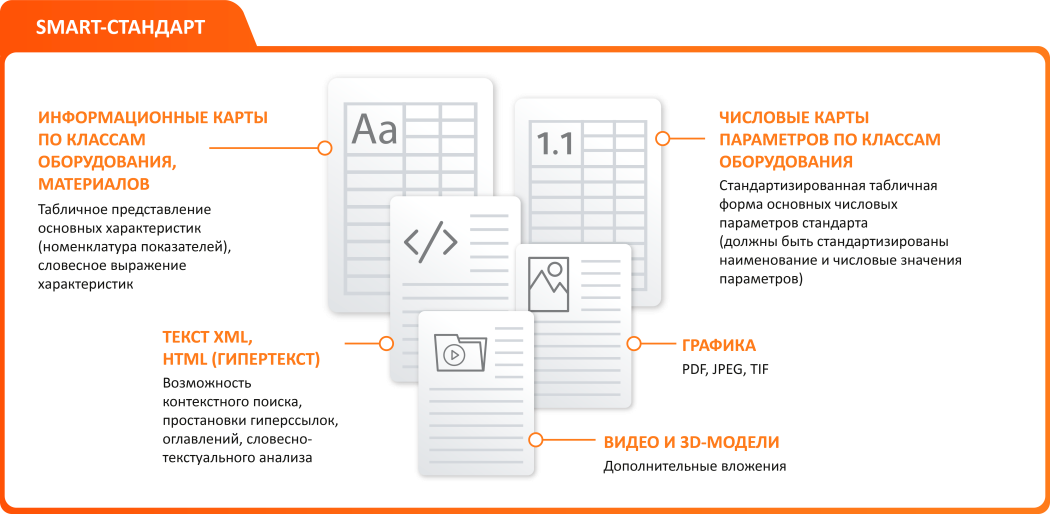
Thus, the standard of the future is not just a document. This is a full-fledged information system.
Are "digitized" and "digital" standards the same thing?
It is important to understand the difference — a digitized document or even a separate business process in an enterprise that has been digitized is not digitalization. The document that gets into your computer is technically digital, of course: any drawing created in a CAD system, a document written in MS Word, just an email or a scanned standard for creating any product is already such if you use it in a virtual space. However, digitalization presupposes a certain level of maturity of a digital document.
Fig. 4. Classification of standards
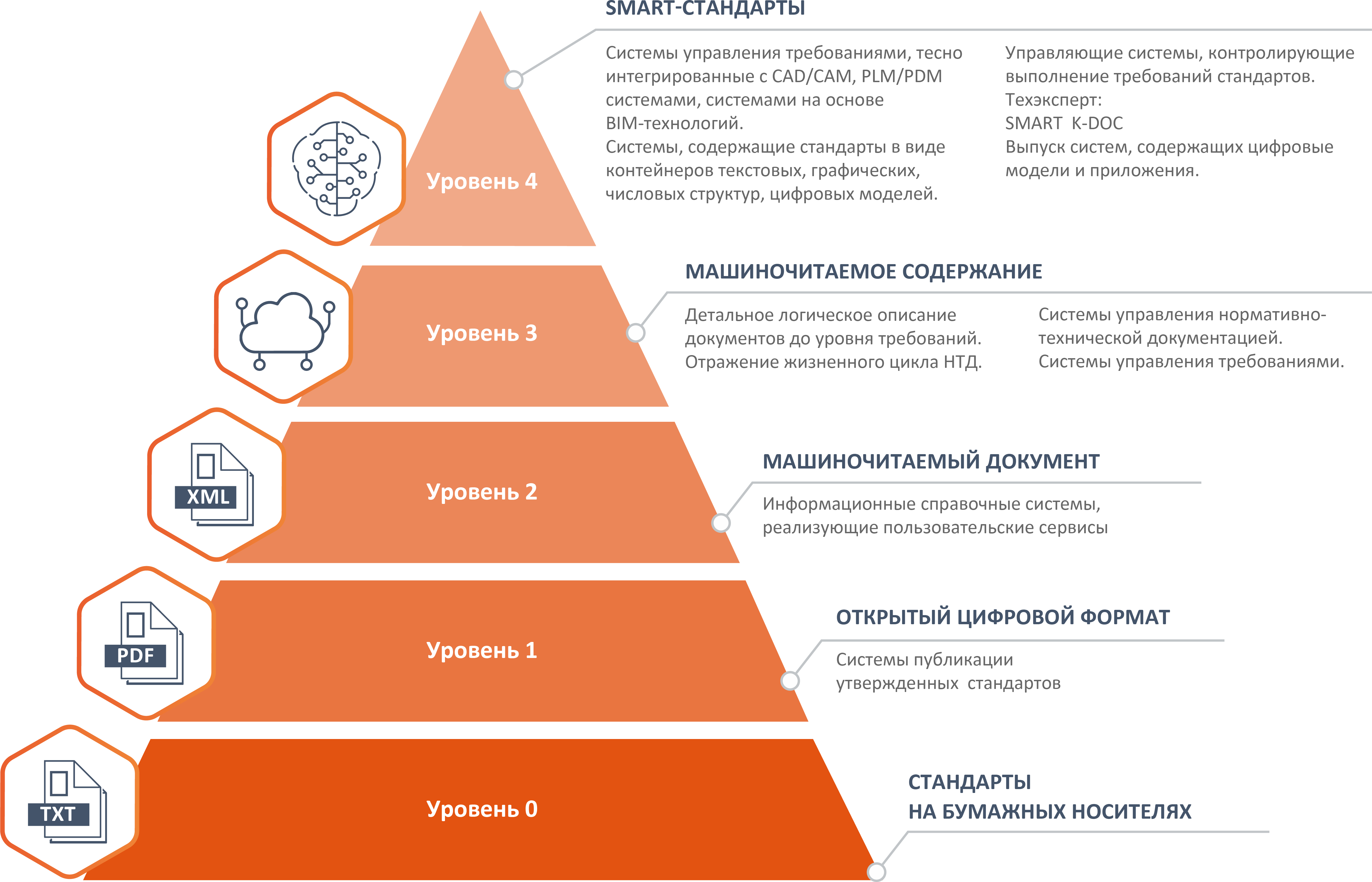
The ISO/IEC Strategic Advisory Group on Machine-readable Standards has created its own classification of machine-readable standards. According to it, a paper document is assigned a zero level of development, and SMART standards are already assigned a fourth level, which speaks not only about transferring information from analog media to electronic media, but also about changing the nature of this information, as well as how it is used. The developers of SMART standards will have to make sure that in the future an engineer can open this document system in a convenient environment and see the entire set of data necessary for the implementation of his idea - a text block of information, information models, product requirements related to each other, and highly functional services that allow you to create the objects are faster and better.
How will the concept develop? SMART- standards in an era of change?
What should be inside a smart document, and what properties should it actually have? Since March 1, 2022, experts have already begun discussing the first version of the preliminary national standard "Smart Standards. General provisions". This means that the Russian business community will soon determine the principles of developing SMART standards, develop requirements for them, and begin developing the first standards of this type.
So far, it follows from the definition of SMART standards that its main logical unit is a requirement, and it is to this, and not to the entire document as a whole, that additional data should be linked. This approach coincides with global trends — SAE International, AFNOR and other standards organizations share their requirements. On the other hand, the same approach meets the needs of Russian users of the standards.
In response to the new market challenge, the Codex Consortium has started creating a line of software solutions called the Requirements Management System (Techexpert SUTr), which is designed to read, create, discuss, and "enrich" requirements with additional data. With this system, in the future, businesses will be able to isolate requirements from the documentation they need and fully manage them, including exporting their machine-readable components to external information and cyber-physical systems.
Techexpert SUTr: from Registers of regulatory requirements to ontological models
The main product of the Techexpert platform, which contains requirements, is the circulation Registers of regulatory requirements for human reading. In these registries, the specialist will be able to obtain collections of requirements from important documents. The user will not be able to edit the requirements themselves, but they will have easy access to them, automatic relevance control, and many other services, including intelligent search and various sorting methods. The main purpose of such a registry is to ensure that all employees of the company comply with existing process/product requirements without having to independently extract these requirements from documents and constantly monitor their relevance. In a broad sense, specialists will have the opportunity to check their designed products for compliance with regulatory requirements, which will allow them to ensure the quality of product sales and successful testing by the inspection authorities.
Fig. 5. Patterns of Sutra usage

Among the ways to use the Techexpert Sutras is also the creation of ontological models (electronic structures) of products and a database of requirements for managing "digital twins" throughout the product lifecycle. Here it is possible to export text requirements to various documents, and machine—readable requirements to external information and cyber-physical systems. SUTr is a very flexible software product that involves the creation of a wide variety of services, including integration. It is possible to expand the scope of the system indefinitely — within the framework of the needs and capabilities of each enterprise.
What awaits the development of technology SMART- standards in the future?
Today, specialists in the field of construction and mechanical engineering are particularly interested in Sutras, but gradually the need for requirements management will grow in other industries. Initially, foreign experience was taken into account when developing such a system. In particular, IBM Rational DOORS and similar systems. In Russian practice, the Techexpert SUTr is so far the first and only project of this scale, which today can meet the goals of domestic enterprises in terms of working with requirements and successfully solving import substitution problems. This is a completely Russian system, included in the Unified Register of Russian Software and having all the necessary licenses.
However, SUTRA systems are one of the most important, but not the only systems that can reach a new level when using SMART standards. SMART standards offer great opportunities to accelerate, optimize, and automate the application of regulatory requirements. But in order to begin their widespread use, it is necessary to change both the standardization system itself and the practices of applying standards and other regulatory documents "on the ground". For the development of such technologies, standard developers should receive tools for "enriching" documents with machine—readable data, and users should receive tools for correctly reading and transmitting this data to external systems: product lifecycle management (PLM), computer-aided design (CAD), control of CNC machines (CAM), and many others. At the same time, the interfaces of the systems for the developer, distributor and consumer of the SMART standard should be friendly and give an idea of the machine-understandable content without knowledge of programming languages. Software products and content for solving all these tasks are currently being created by Codex Consortium developers based on the Techexpert digital platform.
Learn more about the application of the Industry 4.0 concept in Russia, SMART standards and services based on them, as well as working with requirements on the Techexpert platform!
https://cntd.ru/sutr
8-800-555-90-25.
More news
-
Future specialists of the Belarusian electric power industry have reached the semi-finals of the CASE-IN championship
12 Apr 2022 -
Students of Stavropol Territory – in the semifinals of the CASE-IN championship
11 Apr 2022 -
Anniversary season "CASE-IN": the PETROLEUM CHALLENGE game was held in Almetyevsk
11 Apr 2022 -
In the X season of the "CASE-IN" championship, specialized universities organize anniversary activities
11 Apr 2022
Чтобы оставаться в курсе последних новостей, подписывайтесь на нас: