Future metallurgists of the Chelyabinsk region demonstrated innovative solutions
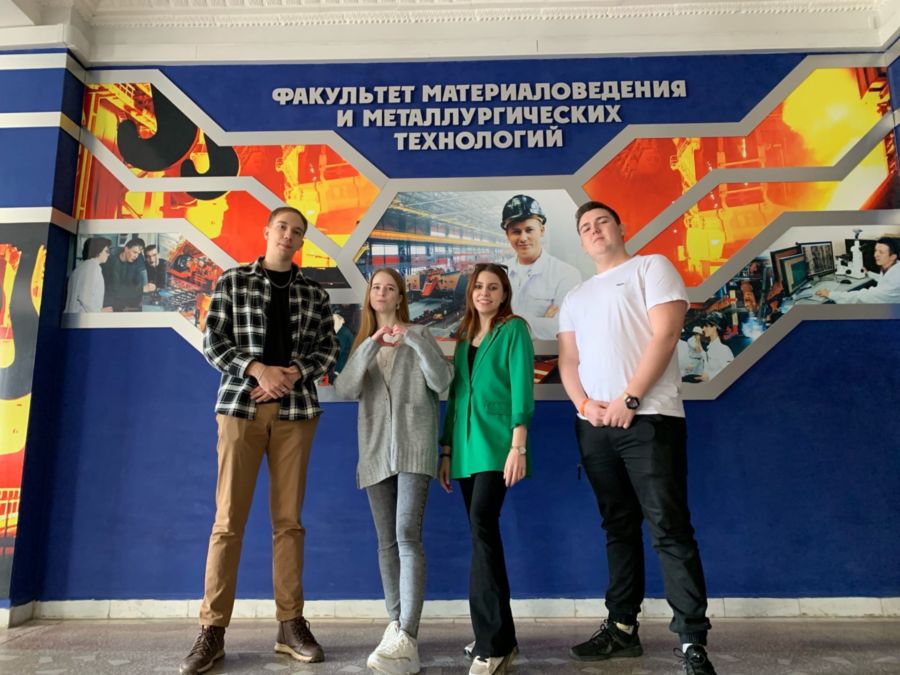
The qualifying stage of the CASE-IN International Engineering Championship in Metallurgy was held at South Ural State University. This is a practice-oriented competition based on solving a real production task prepared based on materials from an industry company or department.
This event is very important for future specialists, as it provides an opportunity to get to know the leading companies in their industry, apply their knowledge at the university in practice and prepare a unique sales offer.
The team of South Ural State University called "Bimetallic vanity" became the winner of the competition. It consists of third-year bachelors of the Polytechnic Institute of Materials Science and Technology. Team Captain Pavel Nifantiev, responsible for technology correction and analysis, Danil Afanasyev, responsible for idea generation and information retrieval, Natalia Cherkasova, responsible for information retrieval and conceptual integration of ideas and Ksenia Rybalchenko, responsible for final calculations, physical activity and good mood. The team's motto is "Veni, vidi, vici. We will make it through!"
The task of the case was to modernize aluminum production based on Industry 4.0 technologies.
"This task was not easy for our team, but at the same time it was interesting and exciting. To solve this problem, the electrolysis process was chosen as the most interesting and important process. First of all, the graphite anode was affected. In this process, the anode actively burned with the release of CO and CO2, which led to great environmental consequences. Also, its service life was only 30 days, which is not enough for such a large production. The team proposed an inert metal anode, which increased the service life and eliminated the release of CO and CO2. Its shape has also undergone a change. Instead of the usual graphite anode in the form of a parallelepiped, we offer an inert metal one in the form of a perforated structure formed by longitudinal and transverse anode elements. Further, to automate the process of monitoring the state of the electrolyte, an isolated punch was introduced, which, using the electrolyte resistance, could determine its cryolite ratio, which eventually made it possible to automate the electrolysis process by electrolyte components.", - tell the team members.
More news
-
Micromine, the partner of the championship, helps specialized universities educate future miners
06 Apr 2022 -
The results of the qualifying stages of the CASE-IN championship have been summed up in Magnitogorsk
06 Apr 2022 -
Students of the Trekhgorny Institute of Technology of the National Research Nuclear University MEPhI – in the semi-finals of the "CASE-IN"
05 Apr 2022 -
Young specialists of PJSC "T Plus" modernize heat supply
04 Apr 2022
Чтобы оставаться в курсе последних новостей, подписывайтесь на нас: