"CASE-IN" is an effective indicator of the quality of education: interview with the rector of UGSU
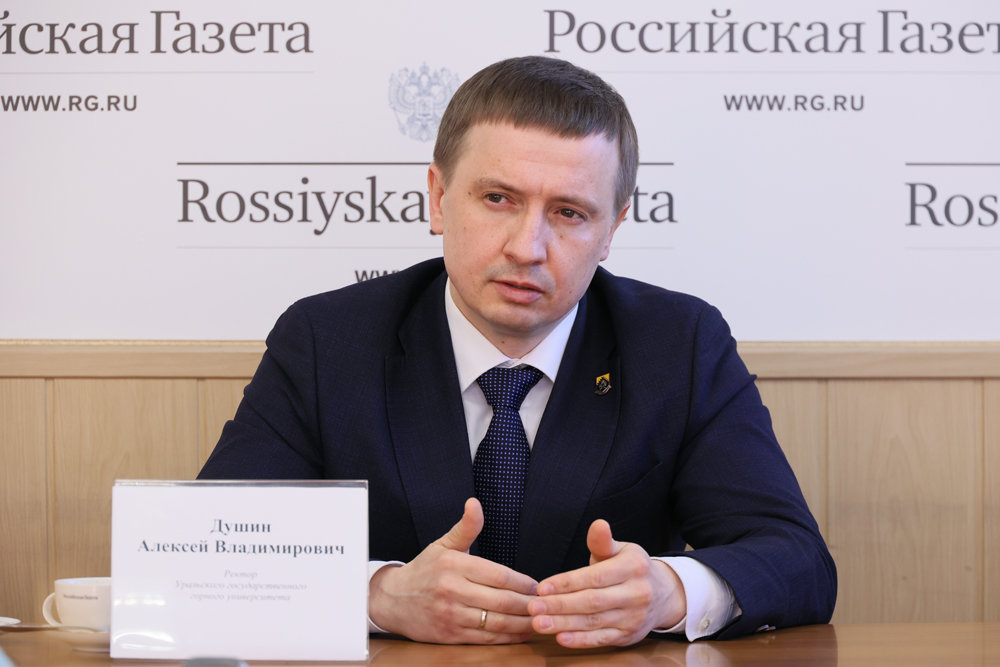
Distance learning, training of future specialists, and the demand for graduates in the labor market. Alexey Dushin, Rector of the Ural State Mining University (UGGU), told Rossiyskaya Gazeta about important topics for Russian education and industry.
UGSU is a partner of the Reliable Shift Foundation and its flagship project, the CASE-IN International Engineering Championship. The university is one of the venues for the Student League competitions of the project, and students of the Sverdlovsk region regularly demonstrate innovative solutions for the country's industry.
- With On April 11, Gorny students return to their studies in the traditional format - in the classrooms of the university. Is it pleasing?
- Of course, this is very important for us. Although the 100% distance was only in the first months of the pandemic, the rest of the time the students studied in a mixed format: practical, laboratory classes were held at the university, because it is impossible to work with the substance online. We will make every effort to ensure that the next academic year is held offline only.
- Has the quality of knowledge at the distance decreased?
- In the near future, we will conduct a large-scale knowledge analysis to assess the losses and figure out how to make up for them. In my opinion, the distance learning form does not provide the necessary closeness of connections between the teacher and the students. A lot is determined by their independent life activity, and it's different for everyone. Knowledge remains the same - it is absolute. But the frequency and density of communications are changing. This leads to a change in value orientations: many students work, and when the "work or study" dilemma arises, the priority begins to shift. But we strive to ensure that full-time education still comes out on top and the guys do not deprive themselves of the future, which is impossible without high-quality education.
- Many university leaders see many advantages in the combined learning format and intend to preserve the elements of online learning. And you?
- We have used distance learning technologies before, even 10 years ago, in additional education, by correspondence, full-time. For those who already work in production, who live far away, this is a very convenient format. In addition, we have given departments the right to independently choose the format of their thesis projects. But the main training at a technical university should be offline.
As you know, Rostechnadzor does not allow people without basic technological education to enter certain types of work, and this is justified. Can you imagine what would happen if mining operations (and these can be explosive and other dangerous and very responsible types of work) were conducted by a person who had seen all this only on a computer?! Therefore, our position in this regard is unequivocal. By the way, in Canada and Australia, where digital, completely deserted remote-controlled mines are already operating, basic training is conducted offline or in a mixed format.
Higher education is for higher education - we create professionals out of schoolchildren, immersing them in a tangible, real context, teaching them to solve complex practical tasks that require meaningful approaches based on a deep understanding of the properties of matter. It is also important that we add history, art, sports and others to the mathematical and engineering disciplines that promote self-realization, harmonious personal development, and the formation of correct life values.
- What are the positions of UGSU among Russian universities today?
- To assess the quality of training, there is such a mechanism - solving engineering cases. So, in mining and geology, we have the second or third position in Russia out of dozens of universities in the CASE-IN rating. Among engineering schools in general, we are still outside the fifty leaders, but we set ourselves the goal of entering the top 30.
- In my opinion, the most objective criterion for the quality of education is the evaluation of customers. How much demand are your graduates?
- The situation in the industry is such that for every one of our graduates there are from 2 to 7 vacancies. That is, students have a real choice. As a rule, many people are already employed in the 4th year. Many universities have good engineering training, but graduates are very strongly attached to urban agglomerations. The result: the former Moscow mining engineer currently teaches mining to only 140 people in all areas of training. We have about 600 students in our course alone. But the industry needs not just specialists, but people who are open to change, including those who are ready to travel to other regions to build a career there. Our guys are just like that. At UGSU, approximately 45 percent of students come from small towns rather than megacities - they have a real understanding of the industrial area.
- What, besides guaranteed employment, does Mining attract applicants?
- Since 2021, we have been one of the first in Russia to provide the opportunity to receive two qualifications within the framework of one diploma. Students can expand their competencies through additional educational modules, and we are increasing their number, including through the electronic information educational environment. A number of networking programs have also been launched, implemented jointly with other universities, for example, with USUE, Perm State University, Moscow Geological Exploration. In addition, motivated students have the opportunity to engage in basic science and applied research using an excellent laboratory base - we have allocated 10 percent of the university's budget for its renovation in 2021 alone. By the way, the number of budget places is quite large and has been growing in recent years.
- This year, the Mining University will celebrate the 85th anniversary of the Ural Geological Museum. Why is the museum so important for the university?
- This is one of the key assets of the university, making it unique. Next year we will also celebrate the 300th anniversary of the Ural Mining School. So, the museum is just an important result of the work of this school - a legacy that is absolutely in demand. The museum's funds contain many collections. There are popular ones whose task is to show visitors, including the smallest ones, the world of minerals, to form a stone culture that is traditional for the Urals. But there are also systematic collections that are of interest to very high-level specialists. Admission to the museum is free for UGGU students, although there are special educational collections for studying at the university. By the way, the importance of this object is reflected in the book of honorary visitors - there is simply no second one like it in Russia, such bright people from the world of politics, culture, and business have left their reviews there: Mao Zedong, Josip Broz Tito, Indira Gandhi and others. Our museum is not just a legacy of the university, but a visiting card of the city and region.
The full version of the interview is on on the RG website.
More news
-
The student team from Mytishchi became a semi-finalist of the CASE-IN championship
02 Apr 2022 -
Lipetsk students have developed a new aluminum production technology
31 Mar 2022 -
Future geologists from MGRI advanced to the semifinals of the CASE-IN championship
31 Mar 2022 -
YATEK, the partner of the championship, helps train high-quality personnel for the oil and gas industry
30 Mar 2022
Чтобы оставаться в курсе последних новостей, подписывайтесь на нас: