Future petrochemical specialists from KuzSTU presented their projects
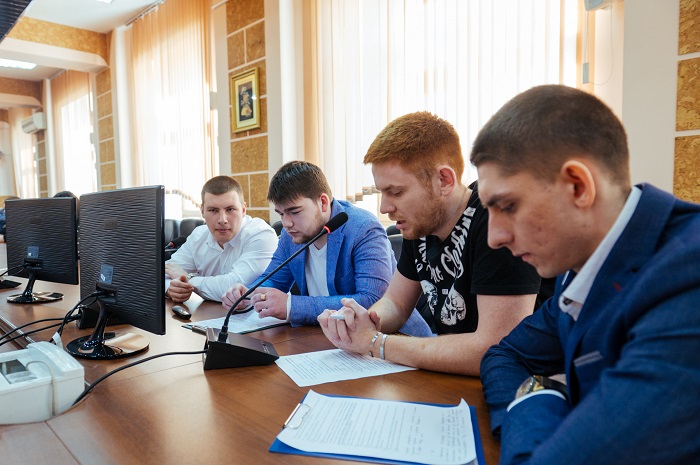
The qualifying stage of the X International Engineering CASE-IN Championship in the field of Petrochemistry was held at the Kuzbass State Technical University. The solution of the cases was presented by seven teams from Kuzbass Polytechnic University and a team from the Far Eastern Federal University. The experts in this area were the teachers of IHNT and representatives of PJSC SIBUR, a strategic partner of the direction.
The solutions to the anniversary season's cases will combine the main theme - "Industry 4.0", and the main issues - how to introduce modern technologies, artificial intelligence, robotics and digitalization of processes, how to use the capabilities of augmented and virtual reality in industrial enterprises in Russia. In their cases, the students "tried on" and suggested possible options for using key technologies of the fourth industrial revolution in the oil and gas chemical industry.
Vera Andrianova, Alexander Gusarenko and Margarita Malyugina joined the "Many Minds and Courage" team. In their vision of the industrial enterprise of the future and the solution of the case, they relied on a key factor – the preservation of jobs. According to the students, a kobot (collaborative robot), an automatic device that can work in conjunction with a human, will help a person avoid mass unemployment, but achieve greater safety and productivity in production.
"The robot works in symbiosis with the operator and does the work that a human might not be able to handle. This is a step into the future, in which a person remains at his job, but performs tasks with jewelry precision and speed, and is freed from a number of routine tasks, for example, welding seams during pipeline installation.", - says Alexander Gusarenko.
The guys also foresaw that the use of robots and other digital technologies would lead to a problem of lack of energy. A potential and environmentally friendly solution here may be solar panels on nano-antennas, which convert solar and infrared light into electrical energy.
The Dangerous Elements team considered digital vision to be the most promising area for industrial use.
"The product, moving along the conveyor belt, passes through a reader that captures an image of an object and converts it into a digital signal. The board processes the signal and transmits the processed information to an automatic actuator, which performs the corresponding action based on the monitoring results., - the guys explain the main principle of digital vision. – The technology has already shown good results, for example, the inspection of defective steel or the recognition of the brand of a rubber briquette has been automated."
The Polymerschikov team proposed using the capabilities of artificial intelligence to sort polymer waste. It is polymers that occupy a larger volume in the structure of waste that pollutes the environment, and the type of polymer material is also more difficult to determine, which leads to poor-quality sorting.
"We came to the conclusion that the best way to label such products is to use a stable type of paint compatible with a polymer material., - notes Angelina Vetoshkina, the captain of the team. – It is easy to implement, the paint does not affect the quality of the material, the paint is easier to identify to the scanning device, it does not deform, unlike the markings on the product."
In this way, artificial intelligence will help reduce errors and increase the scale of a well-sorted product.
All the decisions of the teams have received expert comments, the results of the qualifying stage will be announced in the coming week.
The results of the qualifying stage in the direction of "Electric Power Industry" were recently published, the teams "El-Ectron" and "EDS" received more points and a ticket to the next stage.
More news
-
Future power engineers of the Novosibirsk region have identified the semi-finalists of the CASE-IN championship
25 Mar 2022 -
SamSTU students reached the semifinals of the CASE-IN championship
25 Mar 2022 -
ROSSETI FGC UES educates future electric power engineers at the CASE-IN Championship
24 Mar 2022 -
The race "Together with the "CASE-IN" invites you to the start!
23 Mar 2022
Чтобы оставаться в курсе последних новостей, подписывайтесь на нас: